Top
What a training load actually does to a body between sessions
Training does not make an athlete fitter while it is happening. The adaptation is assembled afterwards, and most of the interesting work happens when nobody is watching.
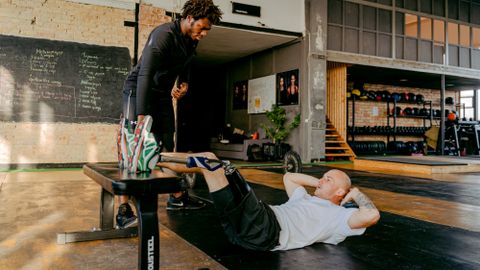
The session is the stimulus, not the gain
A hard session leaves an athlete measurably worse than it found them, with force output down and coordination slightly degraded for hours afterwards. The training effect is not delivered during the work itself but assembled in the hours and days that follow it.
Muscle, tendon, bone and the nervous system each read the same session differently and respond on timelines that do not line up. Coaches who judge a session only by how it felt are reading the stimulus rather than the outcome, which is how programmes quietly drift.
Why fatigue and fitness move on different clocks
The useful model treats a session as adding both fatigue and fitness, with fatigue larger at first but fading considerably faster. Performance on any given day reflects the balance between the two, which is why an athlete can feel flat and still be improving underneath.
Because fatigue decays more quickly than fitness, a stretch of reduced work can reveal capacity that was already present but masked. The same arithmetic explains why an athlete who never eases off can accumulate fitness they are never in a position to express.
Protein turnover and the rebuilding that follows
Resistance work raises the rate at which muscle protein is both broken down and rebuilt, and the rebuilt fraction is what accumulates over months. That elevated turnover lasts well beyond the session itself, which is one reason a single day tells you very little about the trend. Whether the balance runs positive depends heavily on whether the athlete is eating and sleeping enough to support the rebuilding work.
An athlete who trains hard while chronically under-fuelled is paying the full price of the stimulus without collecting the adaptation. Questions about how an individual athlete should be fuelled belong with a registered sports dietitian rather than with a training plan.
Connective tissue lags behind muscle
Muscle responds to loading faster than tendon and bone, so the ability to generate force can outrun the structures that have to transmit it. This mismatch is one of the reasons problems tend to cluster in the weeks that follow a sudden increase in training volume.
Tendon adapts through repeated exposure to load across long stretches of time rather than through the occasional heavy day. Bone remodelling is slower still and responds to the pattern of loading across months rather than to the content of any single week.
Sleep is where much of it is consolidated
Sleep is the period in which motor learning is consolidated and a good deal of the endocrine work of recovery is carried out. Short sleep does not simply leave an athlete tired; it changes how the very same training load is tolerated the following day.
Travel, evening competition and early morning sessions all compress sleep in ways that training plans rarely account for on paper. Persistent sleep problems are a clinical matter, and an athlete who cannot sleep should be speaking to a doctor rather than improvising.
What the between-session view changes
Treating recovery as a passive gap between sessions leads to programmes that add work whenever an athlete happens to look capable of it. Treating it as the place where adaptation is manufactured changes which variables matter, including sleep, fuelling and the spacing of hard days.
It also reframes monitoring, because the useful question becomes whether the body is keeping up rather than whether the session was completed. None of this replaces the judgement of a qualified coach who can actually see the athlete standing in front of them.
- A session is a stimulus, and the gain arrives later
- Fatigue and fitness decay on different timescales
- Connective tissue adapts more slowly than muscle
Also by Dr. Alex Mercer
- Why motivation usually collapses before physical capacity doesMental Performance
- Energy availability: the idea that separates fuelling from dietingNutrition & Diet
- Screening tests promise prediction and usually deliver descriptionSports Medicine
- Grass, sliding and the loads a tennis knee absorbsWimbledon