Wimbledon
Grass, sliding and the loads a tennis knee absorbs
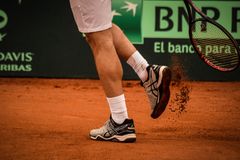
The slide that looks elegant on grass is a controlled failure of grip. What the knee does during that failure explains why the surface asks something different of the lower limb.
Stopping is the expensive part
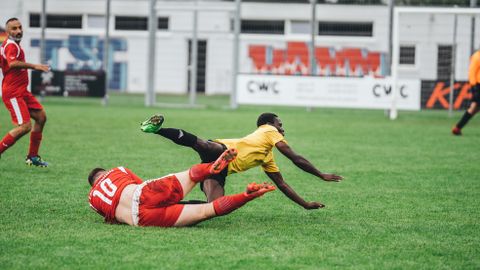
Spectators watch the sprint towards a wide ball, but the mechanically demanding moment is the deceleration that brings the player to a halt. Stopping requires the muscles around the knee and hip to absorb energy while lengthening, which generates higher tension than shortening work does. The shorter the distance over which that energy is absorbed, the higher the peak force travelling through the joint.
This is why a hard stop on an unyielding surface is more punishing than the same movement completed with a slide. Sliding stretches the deceleration over a longer distance and a longer time, which lowers the peak even though the total energy is unchanged.
Why grass permits it and clay demands it
Grass offers relatively low grip when the surface is fresh and slightly damp, so a planted foot can be persuaded to release. Clay is built around sliding as the normal way to arrive at a ball, and players raised on it develop the movement early.
Players who learned on hard courts often reach grass with a stopping strategy calibrated for a surface that does not release. The adjustment happens quickly for some and never entirely for others, which is part of why grass rewards specific movement backgrounds.
The surface changes underneath the players
A grass court degrades measurably across a tournament, with the baseline and the area behind the service line wearing first. As grass wears away, the exposed soil beneath behaves differently again, and grip can vary within a single rally.
Moisture is the other major variable, since damp grass is slick while dried grass grips considerably more firmly. Players are therefore recalibrating an unconscious movement strategy against a surface that is not the same as it was a few days earlier.
What the knee is being asked to resist
During a slide the foot moves while the body above it rotates, which places twisting demand on the structures that stabilise the knee. The ligaments resist rotation passively, while the surrounding musculature contributes stability actively and only if it is prepared for the load.
Fatigue reduces that active contribution, which is one reason movement quality is watched carefully in the later stages of long matches. None of this makes sliding dangerous in itself, but it does explain why the movement is trained rather than improvised.
The low bounce compounds it
Grass produces a lower bounce than other surfaces, so players spend more time in a flexed position to reach the ball. A lower centre of mass increases the muscular work required at the hip and knee across the whole duration of a match.
That posture also lengthens the time each rally spends in positions where the joint is loaded away from its most stable range. The cumulative effect is a different fatigue profile from a hard court, even when the rallies themselves are shorter.
Where preparation ends and medicine begins
Preparing for grass involves familiarisation with the movement rather than any attempt to remove the loads the surface imposes. Players arrive from a clay season with a movement pattern tuned elsewhere and a very short window in which to adjust.
Any knee pain that persists beyond the ordinary soreness of a surface change needs assessment by a physiotherapist or doctor. Self-managing a knee through a tournament on the assumption that it is only the surface is how minor problems become significant ones.
- Sliding converts an abrupt stop into a longer one
- Grass grip changes across a fortnight
- Deceleration loads the knee more than acceleration
Also by Dr. Alex Mercer
- Why motivation usually collapses before physical capacity doesMental Performance
- Energy availability: the idea that separates fuelling from dietingNutrition & Diet
- Screening tests promise prediction and usually deliver descriptionSports Medicine
- What a training load actually does to a body between sessionsTop