ICC
Batting reaction time is not eyesight, and the difference matters
There is not enough time to see a fast delivery and then respond to it. What separates elite batters is prediction built from early information rather than any advantage in raw reaction speed.
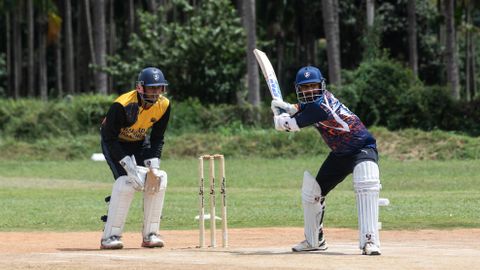
The arithmetic of the delivery
A fast delivery covers the distance to the batter in a period shorter than the time required to see the ball, decide and initiate a full stroke. Simple reaction time in elite batters is not meaningfully different from that of ordinary people when measured in a laboratory. The gap between what the task requires and what reaction can supply must therefore be closed by something other than speed.
That something is prediction, which begins well before the ball leaves the bowler's hand. The stroke itself is largely committed before the ball has travelled far enough for any correction to be meaningful.
Where the information comes from
Skilled batters extract information from the bowler's run-up, the alignment of the shoulders, the position of the wrist and the seam. Much of this happens without conscious awareness, which is why batters often cannot explain how they knew what was coming. The visual system also tracks the early portion of flight, from which trajectory can be projected with reasonable accuracy.
Elite performers appear to sample fewer, more informative regions rather than watching everything with equal attention. This selectivity is what studies of eye movement in expert performers across sports consistently describe.
Prediction can be exploited
Because batters rely on advance cues, any delivery that disguises those cues is disproportionately effective. Bowlers who conceal wrist position or vary release without a visible change are attacking the prediction system rather than the reflexes. This is why a slower ball that looks identical to a quicker one is more troubling than a delivery that is simply fast.
The batter is not deceived by the ball in flight so much as committed by a prediction formed before release. Variation in the field therefore works less by changing the ball than by degrading the reliability of the information the batter is reading.
What this means for practice
Facing a bowling machine removes the pre-release information entirely, since there is no arm action to read. Practice against a machine can therefore develop the stroke while training away the very skill that matters most in a match. Practice against live bowling preserves the cues, which is why it remains central despite being less convenient to organise.
Video based approaches that present a bowler's action and occlude it at the moment of release address the same problem differently. The general principle is that practice should preserve the information a batter will actually have available in the middle.
Fatigue and the perceptual system
Perceptual skill degrades under fatigue before gross motor capacity does, which is why judgement of length deteriorates late in an innings. Heat compounds this, since elevated core temperature affects the cognitive functions on which anticipation depends.
The visible result is a batter playing at deliveries they had left comfortably earlier in the day. Concentration and hydration are managed for this reason, though the specifics for an individual are a matter for support staff.
Why the skill takes years
The cue relationships a batter relies upon are learned through enormous exposure to bowlers rather than taught explicitly. This is one reason players moving between formats or conditions can look temporarily out of touch despite unchanged technique.
It also explains why a batter facing an unfamiliar action struggles until sufficient exposure recalibrates the prediction. The skill is genuinely perceptual, which places it beyond what any amount of physical training on its own can supply.
- Elite batters do not have faster reflexes
- Cues are read before the ball is released
- Anticipation is trained through exposure
Also by Rohan Desai
- Altitude camps: what the blood does and what it does not guaranteeOlympic Science
- Tendons adapt more slowly than muscle, and programmes rarely respect itStrength Training
- Why strength returns before confidence after a knee reconstructionInjury Recovery
- Long-haul travel, body clocks and the international football calendarFIFA