FIFA
Artificial surfaces, natural turf and what the lower limb notices
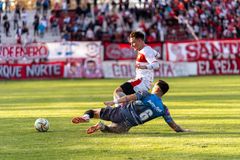
The argument about playing surfaces is usually framed as comfort or preference. The mechanical question is narrower: how the surface releases the foot, and how much energy returns to the leg.
Two properties do most of the work
A playing surface can be described mechanically by how much it deforms under load and by how firmly it holds a boot in place. The first governs how much impact energy is absorbed by the ground rather than travelling up through the athlete's leg. The second governs whether a foot releases during a turn or stays fixed while the body above it continues to rotate.
Most concerns about surfaces concentrate on the second property, because a foot that does not release transmits torque directly into the knee. Both properties shift with the weather, since rain and frost alter how a surface deforms underfoot and how firmly it grips.
Rotational traction and the knee
When a planted foot cannot rotate, the rotation has to occur somewhere higher in the limb, and the knee is the joint that absorbs it. Surfaces with very high rotational grip therefore raise the mechanical demand on the ligaments that resist twisting at that joint. Boot design interacts with the surface, so the same pitch can behave differently depending on the stud configuration a player selects.
This interaction is why blanket statements about a surface being safe or unsafe are difficult to support without specifying the footwear. Studs that penetrate deeply into a soft natural surface can generate grip well beyond anything the shoe alone would suggest.
Energy return and the calf complex
Firmer surfaces return more energy to the athlete, which can make running feel faster and can also increase loading through the calf and Achilles. Softer surfaces absorb more energy, reducing that loading while requiring more muscular work to achieve the same movement.
Neither arrangement is straightforwardly better, since the load simply moves between structures rather than disappearing. What matters more is consistency, because a limb calibrates its landing strategy to the surface it expects to meet.
The problem of switching
Players who move regularly between surface types are repeatedly recalibrating movement patterns that were tuned for something else. The lower limb adjusts stiffness in anticipation of contact, and an unexpected surface response produces a mismatch at the moment of landing.
This is one reason complaints tend to cluster around fixtures where the surface differs from what a squad trains on daily. Adaptation to a new surface appears to occur with exposure, which argues for familiarisation rather than for avoidance.
Heat is a surface property too
Synthetic surfaces absorb solar radiation and can reach temperatures well above the surrounding air on a sunny day. That raises the thermal load on players who are already generating substantial heat internally through the work of the match.
The effect is largest close to the ground, which is exactly where a goalkeeper or a fallen player spends time. Scheduling and watering practices are the usual mitigations, and both are matters for competition organisers rather than players.
Where the evidence sits
Comparisons between surfaces are complicated because pitch quality varies enormously within each category as well as between them. A well maintained synthetic surface and a poorly maintained natural one may have very little in common mechanically. Maintenance standards may therefore explain more of the variation in player experience than the material choice itself.
Player perception is also shaped by expectation, which makes comparisons drawn from player surveys difficult to interpret cleanly. Individual players with a history of lower limb problems should be discussing surface exposure with their medical staff rather than generalising.
- Rotational traction matters more than hardness
- Surfaces change how energy returns to the limb
- Surface temperature is an underrated variable
Also by David Smith
- Anti-doping as a system, and what it is actually designed to doOlympic Science
- What actually narrows when an athlete performs badly under pressureMental Performance
- Load management is a communication problem before it is a physical oneInjury Recovery
- Spin bowling and its quiet demands on the shoulder and the fingersICC